


Nowadays, technology is increasingly focused on making electronics smaller, as many industries – from medicine to aerospace and security – stand to benefit. But reducing the size of devices brings a new challenge: what if they become simply too small to fit a conventional battery, motor, and other mechanical parts?
Recently, we’ve covered an innovative approach to charging drones, where a laser is directed at a battery from a distance. As remarkable as it is, this method doesn’t really address the problem of powering microdevices, as it still requires a built-in battery or energy storage components. This is the problem researchers at the MicroBioRobotic Systems (MICROBS) Lab in EPFL’s School of Engineering are trying to solve. The answer they found is pretty intriguing: sound.
Not just any sound, but specifically Helmholtz resonance. In simple words, it’s the same phenomenon that happens when you blow air across the neck of a bottle. The air trapped inside the bottle vibrates strongly at a certain frequency – that’s why you can hear a humming sound. A glass bottle is an example of what scientists call an acoustic cavity. A cavity can really be any hollow structure, round or bell-shaped, made from 3D-printed plastics, glass, or rubber-like polymers.
2026 EPFL/MICROBS – CC-BY-SA 4.0
When sound waves make the air trapped inside a cavity vibrate, the cavity creates a concentrated stream of air going out. The air coming back in is more spread out than the air going out, and this imbalance is what produces the pushing force, or thrust, needed to move an object.
This is not the first time scientists have used sound to move things. Researchers have long known how to levitate objects with sound waves, but there is an important difference here: in the previous experiments, the passive objects relied on external sound waves to physically push them. But in the current research, the scientists found a way to harness ambient acoustic energy and convert it into mechanical thrust – using sound to generate movement.
“Instead of pushing devices around with sound waves, we have created acoustic resonators that are tuned to harness sound at specific frequencies to generate directional thrust and controlled motion,” explains Selman Sakar, the lab head.
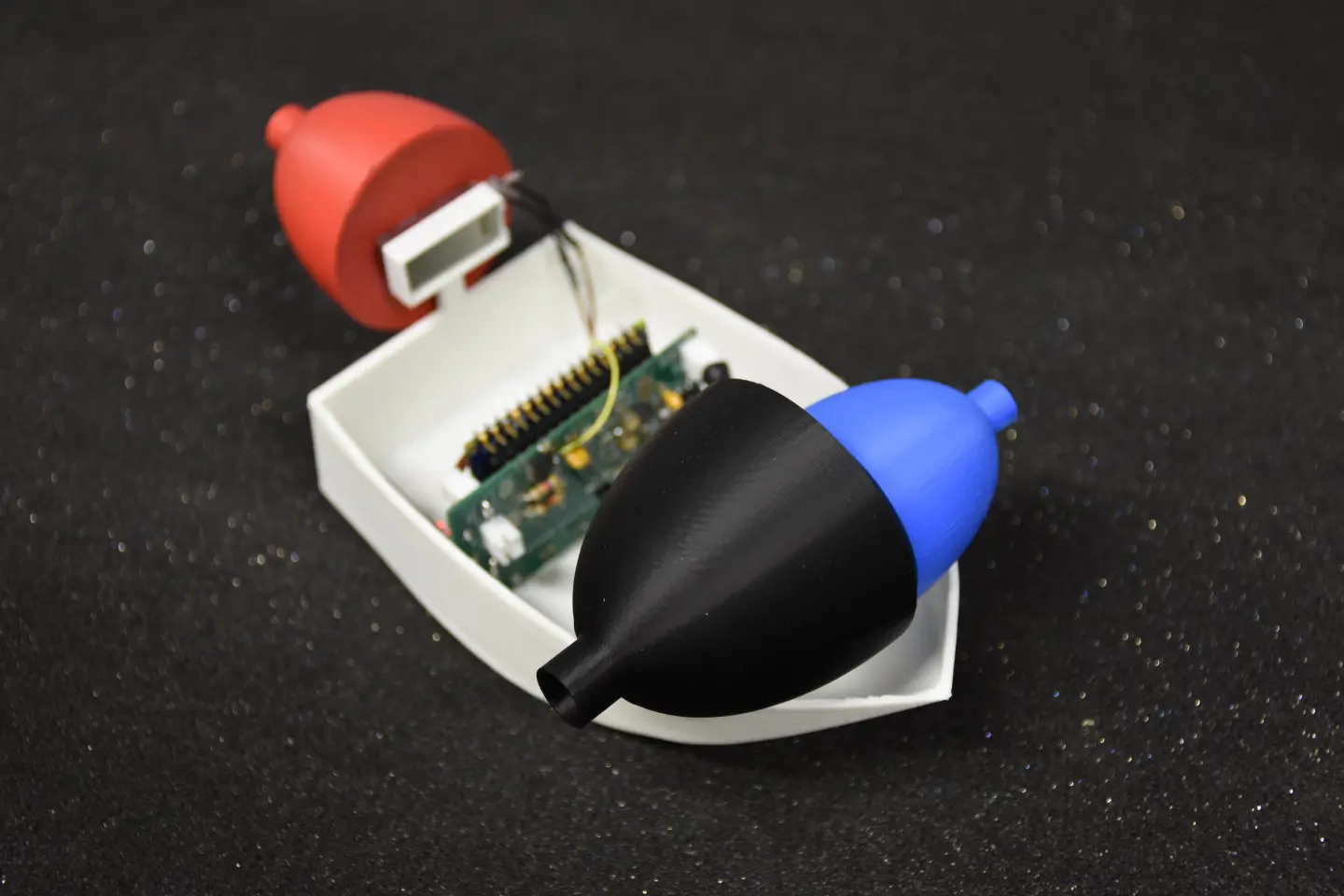
To test this approach, the team first built miniature boats, each equipped with three cavities tuned to different frequencies. This allowed the researchers to activate different cavities by changing the sound frequency and push the boat in a particular direction.
2026 EPFL/MICROBS – CC-BY-SA 4.0
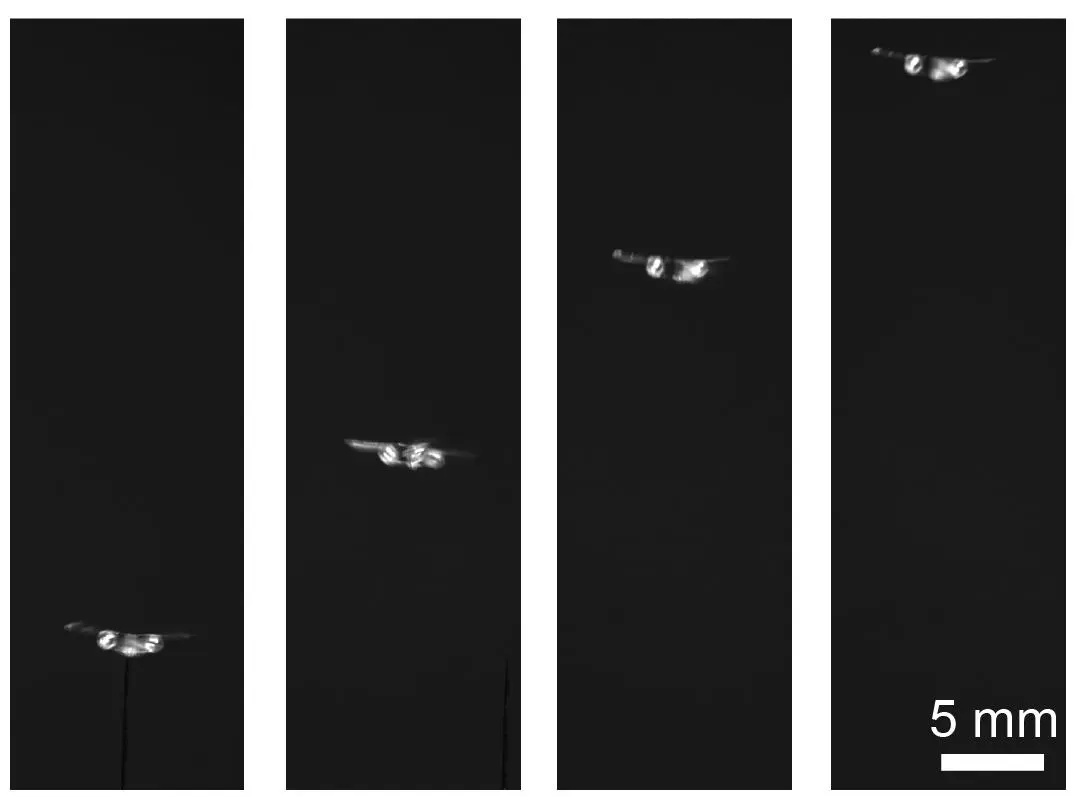
The research team also built so-called microfliers – ultralight, tiny flying drones weighing as little as 150 micrograms, each featuring three microscopic cavities. Those microfliers were powered by ultrasonic frequencies, which are too high for the human ear to hear, and were able to move forward.
2026 EPFL/MICROBS – CC-BY-SA 4.0
Another design combined the cavities with tiny propeller blades. The cavities could generate enough force to spin the blades at 13,000 revolutions per minute, which is an impressively high number. For comparison, regular drone propellers can rotate at several thousand revolutions per minute.
In the future, this innovation could be used to build devices and robots that function without conventional batteries and motors. It could also enable flexible devices with multiple sound-responsive structures, allowing different parts to be activated by different frequencies and to move independently.
Source: EPFL


