


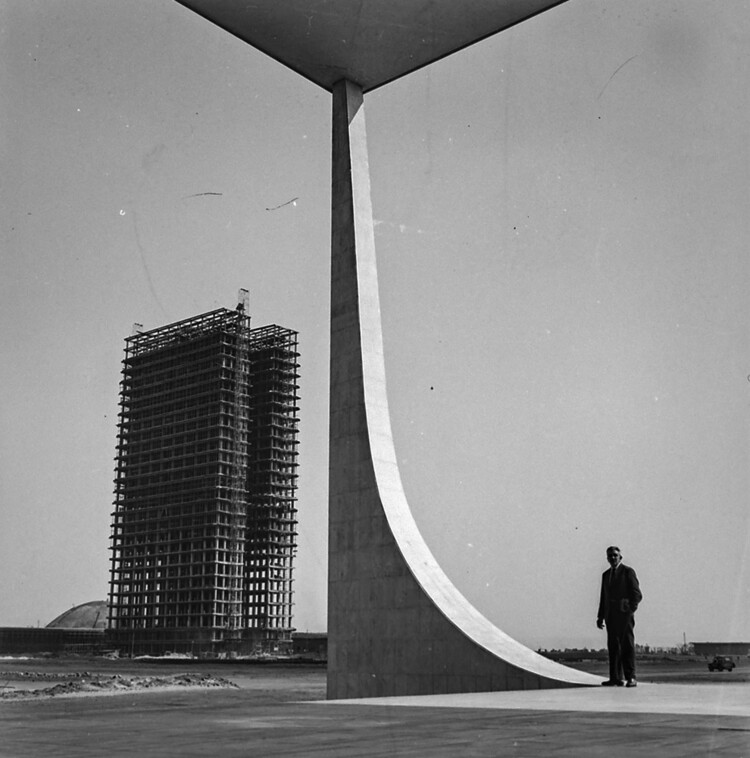
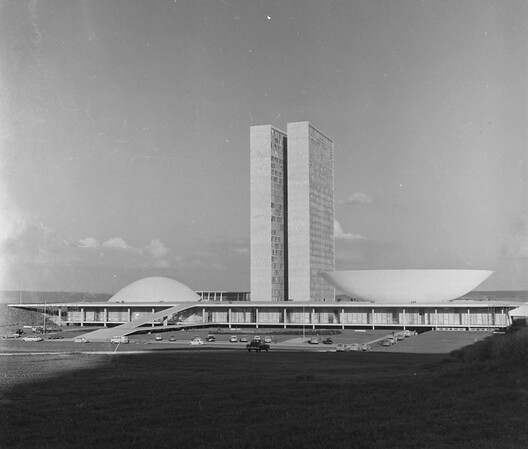
Building a city from scratch is no easy task. It never has been, and it never will be. The very idea of creating something that would otherwise develop and grow gradually demands resources, organization, and, above all, labor. This was the case in 1958, when Brazil’s Central Plateau became one of the largest construction sites of the 20th century for the building of Brasília. Tens of thousands of candangos (migrants coming predominantly from northeastern Brazil, many without prior technical training) arrived to build an entire capital in just over three years, under then-president Juscelino Kubitschek’s motto of achieving “fifty years of progress in five.” Oscar Niemeyer’s architecture and Lúcio Costa’s plan would not have been possible without the assumption that enough workers were available and willing to endure low wages and extremely harsh conditions to transform concrete and curves into a national symbol.




Nearly seventy years later, Brazil faces the opposite situation. Even with government incentives and expanding housing credit, the construction industry is struggling to fill its vacancies. According to data from the Brazilian Chamber of the Construction Industry (CBIC), 94% of construction companies face labor shortages, and more than three in four have to revise project schedules because of insufficient workers. There are shortages of masons, laborers, electricians, rebar workers, and welders. SENAI’s Industrial Labor Map projects that 4.4 million positions will need to be filled in the sector by 2027.
But the shortage of construction professionals is a global phenomenon. In the United States, the Associated Builders and Contractors (ABC) estimates that the industry will need to attract roughly 450,000 workers in 2027. The organization itself notes that much of this immediate demand is associated with replacing workers who are leaving the industry, particularly through retirement. At the same time, although young people’s interest in construction trades has doubled over the past decade in the country, a NAHB survey published in 2026 found that only 6% of Americans between the ages of 18 and 25 who have already identified a professional field say they want to pursue a career in the sector.
The pattern repeats, with local variations, across virtually every major construction market. A global survey by Turner & Townsend shows that around 71% of the 112 markets analyzed across 44 countries face labor shortages, a figure that exceeds 93% in the European Union and reaches 100% of the markets surveyed in Australia and New Zealand. Behind these numbers is a recurring combination of factors: an aging workforce, difficulty attracting younger generations to construction trades, and restrictions on the supply of migrant workers in certain markets.
The Model of Abundance
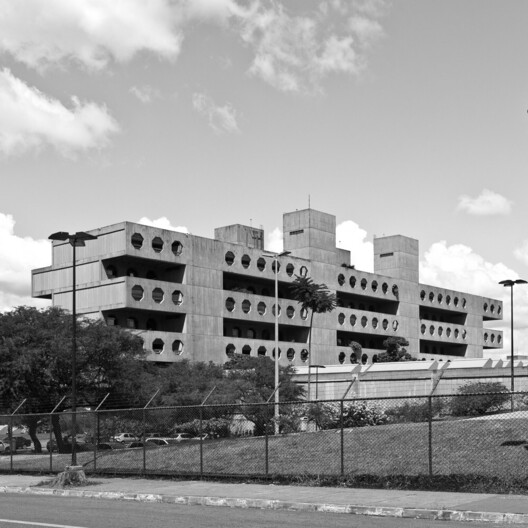
Returning to the Brazilian context, 20th-century construction was built on a structural assumption that the country had a virtually inexhaustible supply of rural labor available to migrate to cities. The rural exodus that intensified from the 1950s onward fueled not only Brasília, but also the broader boom in high-rise construction across Brazilian cities, producing buildings that are now recognized as part of the country’s modernist architectural legacy.
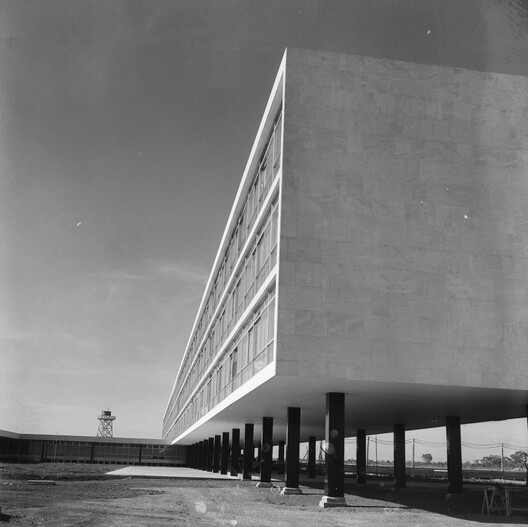
The critic and architect Sergio Ferro argues that much of the formal freedom of modern architecture, including cantilevered slabs, free curves, and sculptural forms in exposed concrete, depended directly on the availability of intensive, low-skilled, and poorly paid manual labor capable of physically executing what the drawings demanded. It was not exactly craftsmanship in the sense of knowledge transmitted and valued across generations, but rather an abundance of labor that made it unnecessary to rethink the construction process itself: there were always more people available to carry formwork, assemble reinforcement, and compact concrete.
Today, Brazil is a predominantly urban country, as is much of the world. The construction workforce is aging faster than it is being replenished, and many already describe the problem as a genuine labor crisis, compounded by the fact that younger generations often associate construction sites with physically demanding and unattractive work, favoring occupations perceived as more comfortable or technology-oriented, including app-based gig work.
The Architectural Consequence
This is where scarcity stops being simply a construction problem and becomes a design problem. Construction has always been a sector particularly resistant to changes in process. While factories have been repeatedly transformed by mechanization, automation, and digitalization, many construction sites continued for decades to operate according to a relatively similar logic: materials arriving in separate parts, large teams performing manual operations, and buildings slowly assembled in place. A photograph of an automobile factory from fifty years ago would probably reveal a production system very different from today’s; a photograph of a construction site from the same period might not look nearly as unfamiliar.
This persistence cannot be explained solely by conservatism or technological delay. For a long time, there were few economic reasons to radically alter a system sustained by the availability of large numbers of workers. In Brazil in particular, rapid urbanization, internal migration, and an abundant supply of low-skilled labor helped make this model viable.
It is this condition that is beginning to disappear, forcing construction companies to accelerate industrialization processes: prefabricated systems, components manufactured off-site, modular solutions, mechanization, and AI-assisted construction management. Industrialization no longer means simply building faster or with greater precision. It also means designing buildings that can be constructed with fewer people.
There is an irony here worth noting. At the same time that parts of contemporary architectural culture celebrate the return of exposed brick, rammed earth, worked stone, or woven bamboo as expressions of material authenticity, local knowledge, and environmental responsibility, the system that actually produces most buildings is moving in the opposite direction: fewer craft-based operations on-site, more industrialized components, more assembly, and more automation. Not necessarily because of an aesthetic or ideological preference, but because the social conditions that once sustained certain ways of building are changing.
This does not mean the disappearance of craft. It may instead signal a shift in its economic position. Craft-based work survives primarily where its cultural, material, or architectural value justifies the time and cost required to carry it out, and where budgets, schedules, and clients can accommodate them. It is a tension similar to that observed in the Indian context: preserving traditional techniques today requires not only preserving knowledge, but also building new economic models capable of sustaining them.
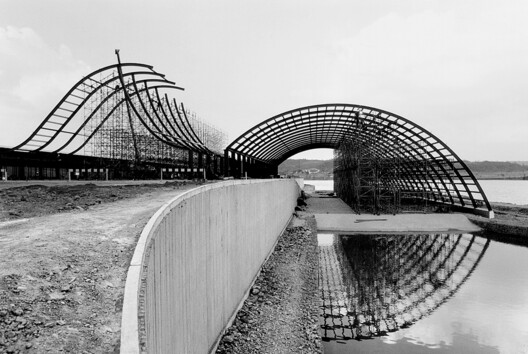
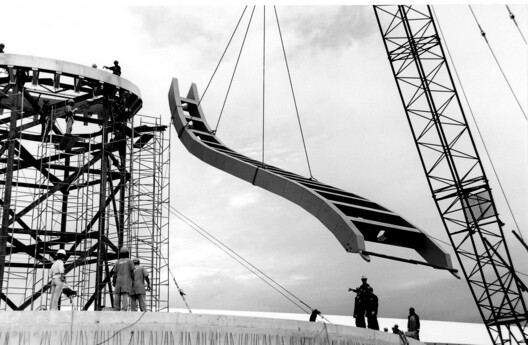
Brasília, however, already pointed toward another model. João Filgueiras Lima, known as Lelé, arrived in the capital while it was still under construction and, through experiments at the University of Brasília in the 1960s, began exploring prefabrication and the rationalization of construction processes. These principles would shape his career and reach perhaps their most sophisticated expression decades later in the Sarah Network of hospitals.
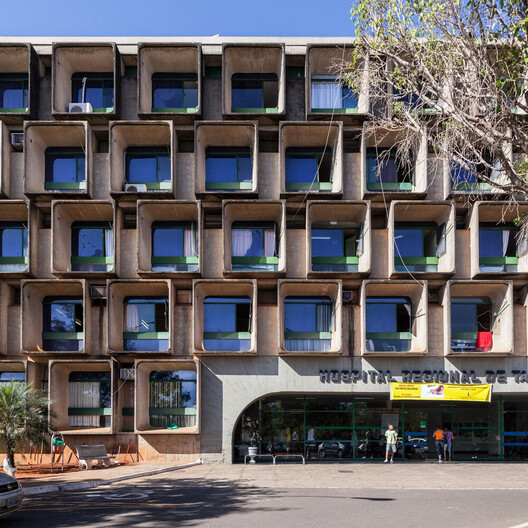
Lelé’s presence makes the story less linear: the industrialization of Brazilian construction did not begin with today’s labor shortage. It already existed as a project concerned with rationalization, speed, and architectural quality. What has changed is its urgency. What for Lelé was a deliberate choice about how to build is now, in many cases, becoming an economic necessity. Precast concrete, algorithm-assisted construction management, and buildings designed to reduce labor demands can therefore be understood not simply as the triumph of technology over craft, but as part of a broader response to a changing labor landscape, perhaps pointing toward what could be described as an architecture of scarcity.
There is, however, an interesting reversal underway. As artificial intelligence advances into cognitive and office-based tasks, precisely the kinds of jobs that for decades seemed to offer greater security, many skilled manual jobs remain difficult to fully automate. Construction sites require the ability to interpret irregular conditions, adapt to unforeseen circumstances, coordinate complex physical movements, and make decisions in real time. The shortage of these professionals is already beginning to increase their economic value and, in some contexts, their cultural visibility as well.
This does not imply a romantic return to craftsmanship. Higher wages driven by scarcity are not the same as valuing craft as tradition, slowness, or transmitted knowledge. The more likely scenario is a bifurcation: automation and robotics absorb repetitive and physically demanding tasks, while human labor becomes concentrated in what remains difficult to standardize, such as finishes, adaptations, and custom solutions. Craft may therefore survive not as the rule of the construction site, but as an increasingly rare, specialized, and costly skill.
This article is part of the ArchDaily Topic: The Architecture of Craft: Handmade Stories in a Digital Age. Every month we explore a topic in-depth through articles, interviews, news, and architecture projects. We invite you to learn more about our ArchDaily Topics. And, as always, at ArchDaily we welcome the contributions of our readers; if you want to submit an article or project, contact us.


